

Is the conflict in Nigeria driven by religious ideology? What explains the persistent insecurity in parts of the country, particularly in the Northeast and the Northwest?
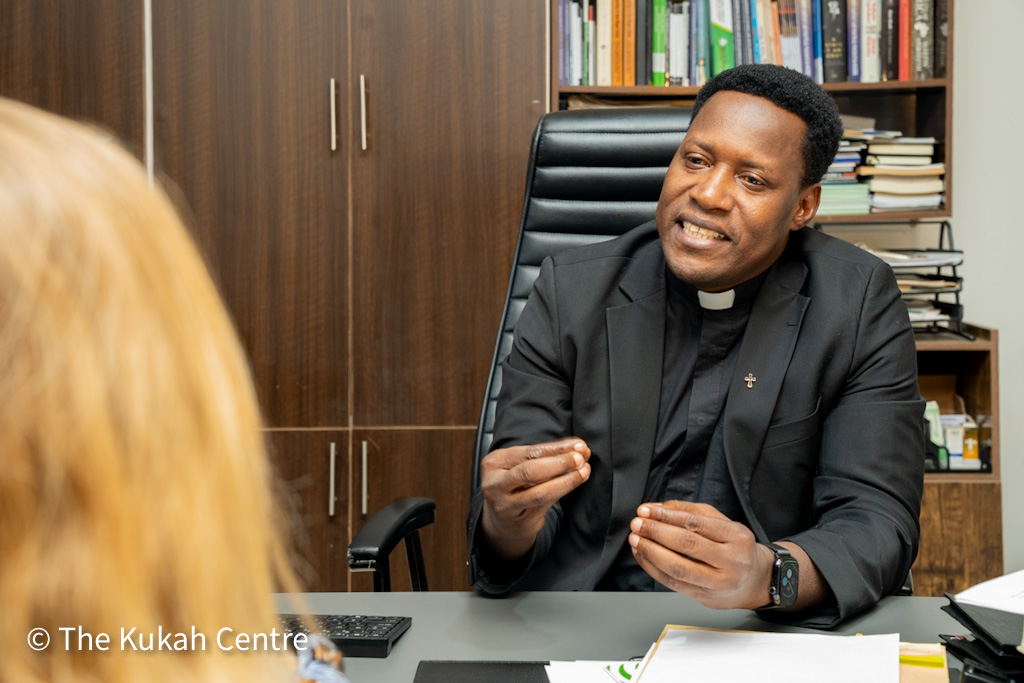
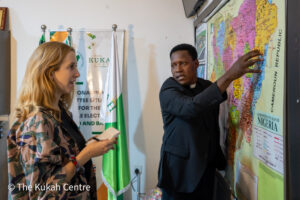
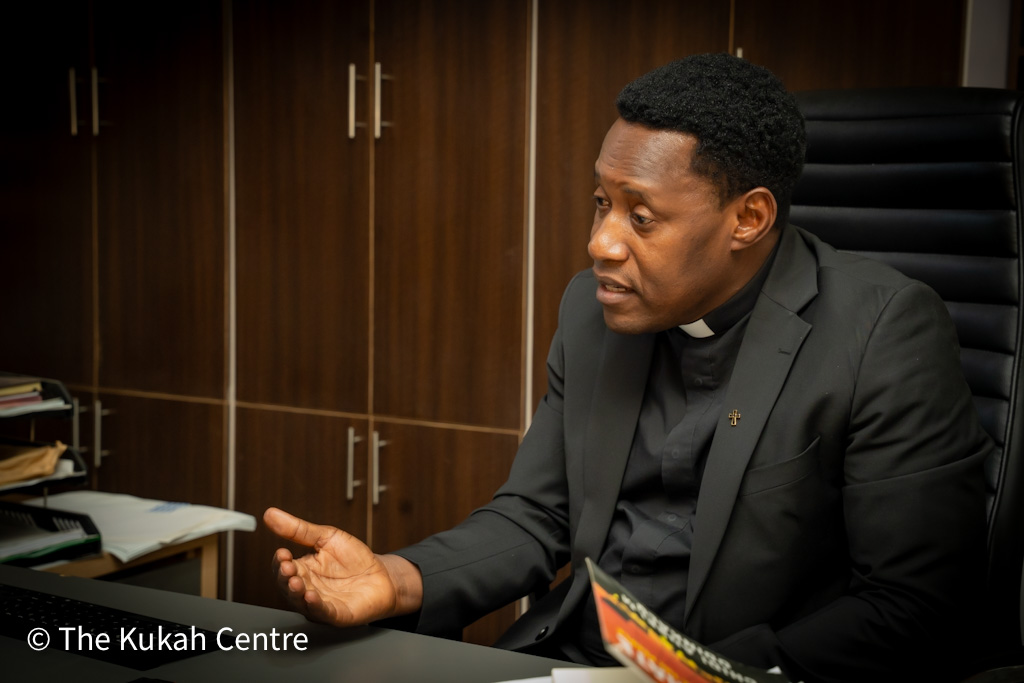
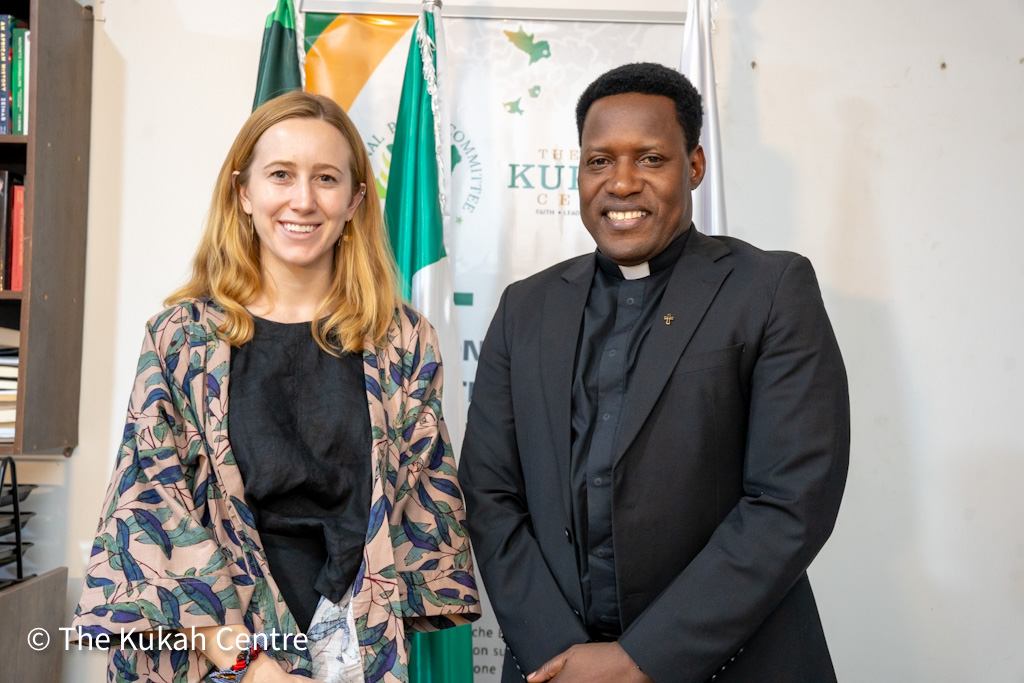
These questions were at the centre of a recent conversation between Rachel Chason, West Africa Bureau Chief of The Washington Post, and Rev. Fr. Atta Barkindo, Executive Director of The Kukah Centre and Head of Secretariat, National Peace Committee (NPC), on 22 January 2026. The conversation dwelt on The Kukah Centre Programme Areas of Good Governance, Interfaith Dialogue and Human Rights Protection.
In the discussion, Fr. Barkindo reflected on the scale of violence across Nigeria and warned against the growing tendency to normalise mass killings. He questioned why the global community often hesitates to describe the crimes accurately, and resort to technicalities instead of given adequate priority to the dignity of lives lost daily.
Responding to claims that Nigeria is facing a Christian genocide, Fr. Barkindo offered a broader perspective: “There is a genocide,” he said, “but it is against both Christians and Muslims who do not believe in the kind of Islam practiced by the perpetrators.” The terrorists and the violent extremist argue that legitimate political authority must be based on Allah’s revelation in the Qur’an. The sovereignty of Allah must be the foundation for all socio-political and economic systems, and society must be governed in accordance with the Qur’an and the Sunna of the Prophet. This means that human beings must, individually and collectively, surrender all rights of lordship, legislation and exercising authority over others. No person, class or group can lay claim to sovereignty.
Allah is the real lawgiver and absolute legislation rests in him. Western education, Judeo-Christian tradition, and democracy are the three elements of the modern world that have conspired to destroy Islam. All good Muslims must stand up and reject them. In fact, democracy is a rejection of Allah’s supremacy over his creation. It is the arrogance of humanity to allocate to itself powers that belong only to Allah.
Fr. Barkindo further noted that for the perpetrators; the terrorists and the violent extremists, both Christians and other Muslims who do not subscribe to this extremist interpretation should be killed. This has been the extremist ideology promoted by revered religious scholars such as Sheikh Ibn Taymiyyah, Sayyid Qutb, Hassan al-Banna, Osama Bin Laden, Abu Musab al-Zarqawi, Abu Bakr al-Baghdadi and down to the leaders of Boko Haram and ISWAP.
However, according to him, victims are targeted not solely because of their faith, but because they reject violent extremism. Muslims who oppose extremist ideologies, he noted, are equally affected.
Fr. Barkindo also rejected the framing of Nigeria’s crisis as merely a religious war between Islam and Christianity: “We are not worried about the peaceful majority,” he said. “We are more worried and concern about the very active minority that have accumulated the capacity and the strategy to mobilise, sustaining their influence among millions of young people across northern Nigeria. We are definitely more troubled about the minority that have been able to articulate a central ideology, establish alliances with regional factions and agencies, build networks and partnerships, delegate responsibilities and undertake resource mobilisation, while killing thousands, if not millions, of people across borders. “We are worried about a set of people that in 2009, policymakers, political analysts, security officials, and scholars defined as a rag-tag group of deranged criminals, whose ambitions would simply fizzle away. Yet they have wrecked havoc across the country, expanded their franchise and created an overwhelming political economy of conflict.
He explained that while religion and ideology played a stronger role in the early stages of the conflict, the violence has evolved into a struggle driven largely by money, control and survival. Armed groups have splintered into factions competing for territory, engaging in kidnapping, extortion and attacks on communities and state institutions. “People suddenly discover they can make millions,” Fr. Barkindo observed, describing how financial incentives now sustain banditry and insurgency.
He further raised concerns about land dispossession and illegal mining, warning that valuable land and mineral resources are being exploited while communities are displaced by insecurity. The long-term environmental and economic consequences, he said, could be devastating.
Fr Barkindo acknowledged that Churches and Christians are still targeted in some areas. The targeting of Christians is beyond physical violence. There are unwritten discriminatory laws against Christians in northern Nigeria where in some places, only Muslims can become traditional rulers, the refusal to allocate land for the building of churches and the application of religious identity in political contestation.
He equally noted that noted that extremist groups are now more focused on revenue generation and territorial control. Religion, he said, has increasingly become a cover for organised crime.
Fr. Barkindo concluded by stressing that Nigeria’s crisis cannot be reduced to a single explanation. Addressing it requires an honest understanding of its political, economic and ideological dimensions, stronger institutions, massive roll out of educational opportunities and the courage to confront the forces that profit from violence.

Great one Sir.
More wins.